
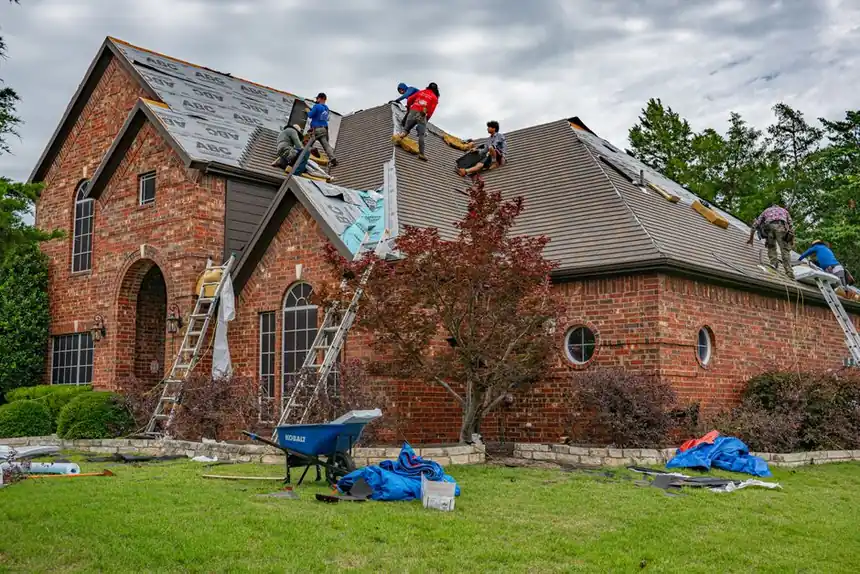
To choose a licensed roofing contractor in Baltimore, verify their Maryland Home Improvement Commission (MHIC) license number, confirm they carry general liability and workers' comp insurance, and get a written estimate that lists materials, labor, and disposal costs. Then check recent local reviews and ask for two addresses of completed roofs you can drive past. That five-step process eliminates 90% of the risk before anyone climbs a ladder.
Baltimore's housing stock is old - nearly half the rowhomes in neighborhoods like Canton and Federal Hill were built before 1950, and their roof structures, parapet walls, and flat sections demand a contractor who has actually worked on them. A license alone doesn't prove that. But it's the first filter, and skipping it is how homeowners end up paying twice for the same roof. This guide covers how to check a license, what questions to ask, what a roof costs in 2026, and the specific red flags we see when we're called to fix another company's mess.
Why Licensing Matters in Baltimore
Hiring an unlicensed roofer in Baltimore isn't just risky - it's a financial trap that can cost you thousands beyond the original quote. The MHIC requires any home improvement contractor performing work valued over $500 to hold a valid license, and roofing is explicitly included. When you hire someone without one, you lose access to the MHIC Guaranty Fund, which can reimburse homeowners up to $20,000 for unfinished or defective work. That fund exists because unlicensed contractors disappear.
Beyond the fund, unlicensed crews typically carry no liability insurance. If a worker falls off your roof, your homeowner's policy may be the one that pays. If a nail punctures a pipe and floods your ceiling, you're negotiating with someone who has no bond and no legal obligation to return. We've walked through dozens of Baltimore homes where the homeowner paid a deposit to a guy with a magnetic sign on his truck, then never saw him again. The license check takes five minutes. The recovery takes months.
Licensed contractors also pull permits. In Baltimore City, a roofing permit is required for most structural work and full replacements. The permit triggers an inspection, which protects you from shoddy decking, improper flashing, and code violations that could void your insurance. An unlicensed roofer will tell you a permit isn't needed. That's your cue to end the conversation.
Maryland Roofing License Requirements
Maryland roofing license requirements are set by the Maryland Home Improvement Commission, a division of the Department of Labor. To obtain an MHIC license, a contractor must pass a criminal background check, provide proof of at least two years of experience in the trade, carry a $20,000 surety bond, and maintain general liability insurance of at least $50,000 per occurrence. They must also complete a pre-license education course and pass a written exam covering Maryland law, business practices, and trade standards.
Once licensed, the contractor must renew every two years and complete continuing education. The MHIC publishes a public database where you can search by name, company, or license number. If a roofer tells you they're "licensed and insured" but can't give you an MHIC number, they're either unlicensed or working under someone else's license - both are problems.
Some roofing companies also hold a Maryland Home Improvement Commission license under a different business name than the one on their truck. That's not automatically a scam, but it's worth asking why. We've seen out-of-state storm chasers operate under a dozen different LLCs, each with a different license status. The MHIC number is the only thing that ties them to accountability.
How to Verify a Roofing Contractor License in Maryland
To verify a roofing contractor license in Maryland, go to the MHIC website, enter the license number or company name, and confirm the status is "active" and the license type covers roofing. The search takes under two minutes and shows the license expiration date, bond information, and any disciplinary actions. If the license is expired or suspended, walk away - no exceptions.
Here's the exact process:
- Ask the contractor for their MHIC license number before they leave your driveway. A legitimate roofer has it memorized or on their card.
- Visit the MHIC public database and search that number. Check that the name matches the person you're talking to and the company on the estimate.
- Look for the bond and insurance expiration dates. If the bond lapsed last month, the contractor is operating illegally.
- Call the MHIC at (410) 230-6309 if the online record looks confusing. They'll confirm status over the phone.
- Ask for a certificate of insurance directly from the contractor's insurance agent - not a photocopy from the contractor's binder. The agent will email or fax it same day.
We hand every customer our MHIC number and insurance certificate before they sign anything. It's not a favor; it's the baseline. If a Baltimore roofing contractor hesitates on this step, that hesitation is your answer.
Questions to Ask a Roofing Contractor in Baltimore
Questions to ask a roofing contractor in Baltimore should cover licensing, insurance, local experience, materials, and warranty terms. The best contractors answer without flinching. The worst ones get defensive or change the subject. Here are the ones that matter most:
- What's your MHIC number, and can I see your insurance certificate today? If they can't produce both, stop.
- How many roofs have you replaced in Baltimore City in the last 12 months? A roofer who mostly works in the county may not understand city permits or rowhome flashing.
- Will you pull a permit, and who pays for it? The permit should be in your name as the homeowner, but the contractor should handle the paperwork.
- What's your warranty on labor, and what's the manufacturer's warranty on materials? Labor warranties under five years are a red flag. We offer a 10-year workmanship warranty on full replacements.
- Do you use subcontractors or your own crew? Subcontractors aren't inherently bad, but you want to know who's actually on your roof.
- Can you give me two local addresses from the past six months? Then drive by. Look at the ridge lines and chimney flashing.
We also recommend asking how they handle unexpected decking rot. A roofer who says "we'll figure it out" is setting you up for a surprise invoice. A roofer who gives you a per-sheet price for decking replacement upfront is being straight with you.
What Does a Roofing Contractor Cost in Baltimore?
Roofing contractor costs in Baltimore in 2026 range from $350 to $1,200 for minor repairs, $8,500 to $18,000 for a full asphalt shingle replacement on a typical rowhome, and $18,000 to $35,000 for a flat roof or a larger detached home. The variables are roof size, pitch, material, number of layers to tear off, and whether the decking is sound. A 1,200-square-foot rowhome roof with architectural shingles and one layer of tear-off usually lands around $9,500 to $12,500.
Emergency repairs after a storm cost more - expect a 20% to 30% premium for same-day service, which is standard across the industry. Metal roofing runs $12 to $18 per square foot installed, while flat roofing systems like TPO or EPDM run $6 to $11 per square foot. We give every customer a written, itemized estimate before work begins, and we don't ask for a deposit until materials are ordered.
Be wary of any quote that's dramatically lower than the others. In Baltimore, a $6,000 full replacement usually means no permit, no ice-and-water shield, and a crew paid by the square with no supervision. The cheap roof costs more when it leaks in year three.
Common Mistakes When Hiring a Roofer in Baltimore
The most common mistake is hiring based on price alone. The second is skipping the license check because the contractor seemed friendly. Both are expensive. Here's what we see repeatedly:
- Paying a large deposit upfront. A 10% deposit to order materials is normal. A 50% deposit before any work starts is a red flag.
- Not getting the estimate in writing. Verbal quotes are unenforceable. You need a scope of work, material specs, and a payment schedule on paper.
- Ignoring the permit. If your contractor says a permit isn't needed, call Baltimore City's permit office yourself. They'll tell you the truth in one phone call.
- Hiring a storm chaser. After a big hail event, out-of-state crews flood Baltimore. They use local addresses as fronts and disappear when the warranty claims start.
- Not checking the warranty transferability. If you sell your house in three years, a transferable manufacturer warranty adds value. Ask about it now.
We've also seen homeowners sign contracts with companies that list a P.O. box as their business address. A licensed Maryland roofing contractor has a physical office or warehouse you can visit. If the address is a UPS Store, keep looking.
When to Call a Professional
Call a professional roofer when you see sagging decking, granules pooling in your gutters, daylight through the attic boards, or a ceiling stain that grows after rain. Those are signs of structural or moisture damage that won't fix itself. Small things - a missing shingle, a loose flashing collar - can wait a week. Active leaks cannot.
If your roof is over 20 years old and you've had two repairs in the last three years, replacement usually costs less than continued patching. We inspect the attic, the decking, and the flashing, then give you a straight recommendation: repair or replace. Sometimes the answer is repair. We'd rather tell you that than sell you a roof you don't need.
RoofPros Maryland handles everything from emergency tarping to full replacements across Baltimore City and the surrounding counties. We're licensed, insured, and we've worked on every rowhome configuration this city has. If you're not sure whether your roof needs attention, we'll take a look and tell you what we see.
Frequently Asked Questions
How do I choose a licensed roofing contractor in Baltimore?
Verify their MHIC license number on the state database, confirm active insurance and bond, get a written estimate with material specs, and check two recent local references. Then drive past those addresses. A licensed contractor will provide all of this without hesitation.
What license does a roofing contractor need in Maryland?
They need an active Maryland Home Improvement Commission (MHIC) license, which requires a background check, two years of experience, a $20,000 surety bond, and $50,000 in general liability insurance. Roofing work over $500 requires this license by law.
How much does a roofing contractor cost in Baltimore?
In 2026, minor repairs run $350 to $1,200, full asphalt shingle replacements on rowhomes run $8,500 to $18,000, and flat roofs run $18,000 to $35,000. Emergency service adds 20% to 30%. Always get an itemized written estimate.
How to verify a roofing contractor license in Maryland?
Go to the MHIC public database online, enter the license number or company name, and confirm the status is active with a current bond and insurance. You can also call the MHIC at (410) 230-6309 to verify over the phone.
What questions should I ask a Baltimore roofer before hiring?
Ask for their MHIC number, insurance certificate, local project addresses, labor warranty length, whether they pull permits, and how they handle unexpected decking rot. Vague answers to any of these are a warning sign.
Get Help with Roofing in Baltimore
If you'd rather skip the vetting process and work with a crew that's already licensed, insured, and familiar with Baltimore's rowhomes, we're ready to help. We'll inspect your roof, explain what we find, and give you a written estimate before any work begins.
Call RoofPros Maryland at (833) 409-1163 to schedule your inspection or emergency repair.